
Stay investor-ready.
Without the scramble.

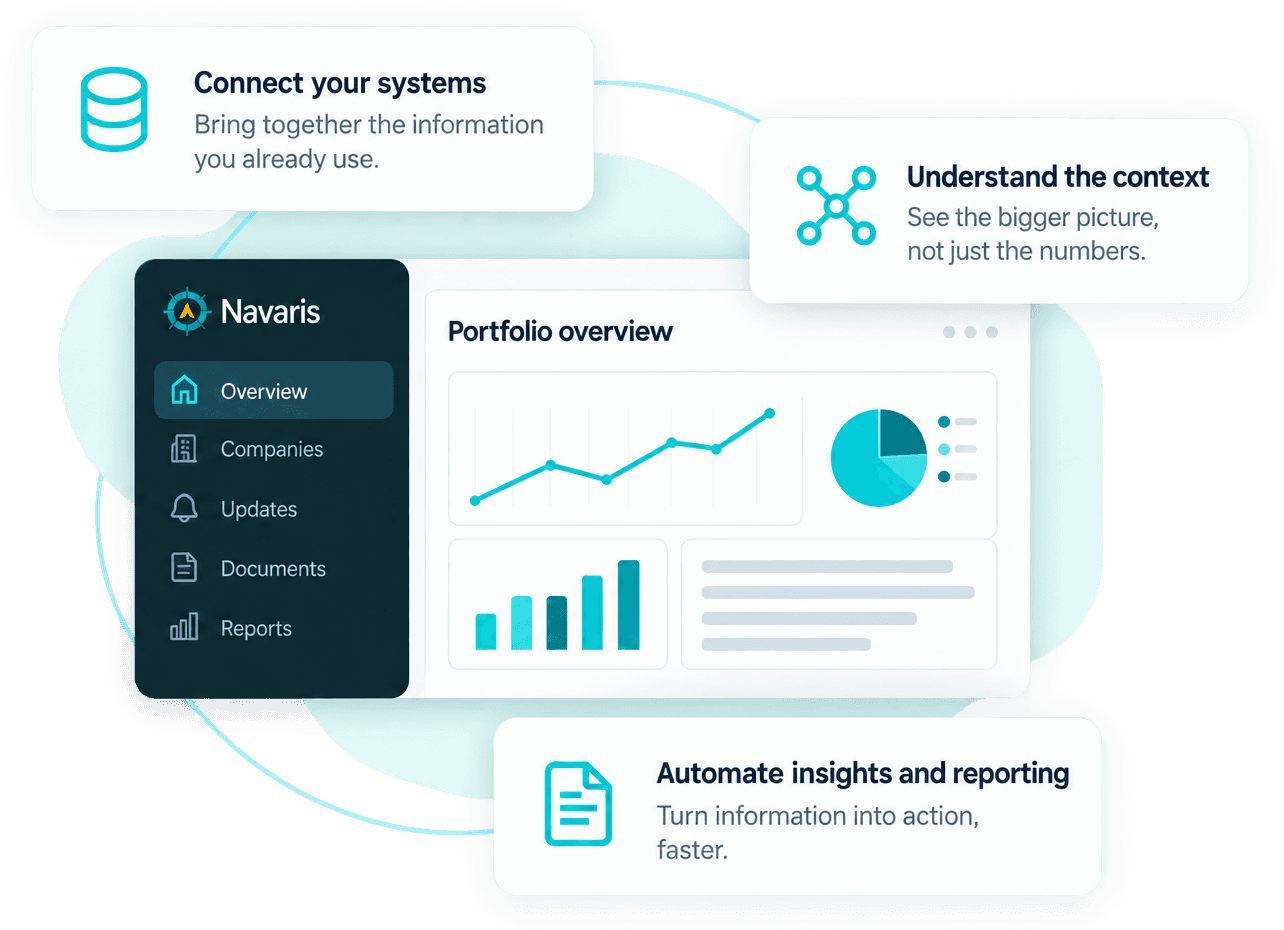
Connect your documents and tools. Navaris builds your data room automatically, keeping it current so you can focus on growth instead of admin.

Live data sync No time-sapping admin

Drop files here

Pitch deck, financials, cap table...

Or connect your tools:
šŸ“Š

Carta

šŸ’°

QuickBooks

šŸ’³

Stripe

ā˜ļø

Salesforce

Building your data room...
Company: TechFlow Inc
Stage: Series B
ARR: $8.2M
Single source of truth

How It Works

From static files to live business understanding.

1

Connect Your Information

Link your documents, systems and tools. We integrate directly with your sources - no manual uploads needed.

Pitch-Deck-2025.pdf

4.2 MB • Just uploaded

Carta

Connected • Syncing...

2

We Index & Understand

Navaris builds a structured, connected view of your business - transforming data into contextual understanding.

Company Name
TechFlow Incvia Pitch Deck
ARR
$8.2Mvia Stripe
Employees
48via Gusto
Cap Table
6 investorsvia Carta
3

Ready to Engage

Your information stays organised and current. Get answers and generate documents directly from live data.

Completion85%
27 documents organised
6 auto-syncing
4 still needed
20+ Integrations

Connect Once, Stay Current Forever

Link your tools and your data room updates automatically. Not a one-off export - an always-current layer you can rely on every time you raise.

Cap Table

Carta, Pulley, AngelList

Accounting

QuickBooks, Xero, NetSuite

Revenue

Stripe, Chargebee, Shopify

CRM

Salesforce, HubSpot

HR

Gusto, Rippling, BambooHR

Banking

Mercury, Brex, Plaid

Live Sync Status All Connected

Carta

Cap table, 409A

Synced

2 min ago

QuickBooks

Financials

Synced

15 min ago

Stripe

MRR, Customers

Synced

5 min ago

Gusto

Org chart, Census

Synced

1 hour ago

Built for Confident Investor Engagement

AI-powered features that remove admin so you can focus on growth.

Automated Data Extraction

Link your documents and we extract the key information automatically. No questionnaires, no manual entry.

Proactive Sync

Connected sources update automatically. Your data room stays current and investor-ready.

AI-Powered Q&A

Investors ask questions, AI answers instantly with cited sources from your data room.

Engagement Analytics

See who viewed what, for how long. Know which investors are most engaged before your next call.

Secure by Design

View-only document rendering, dynamic watermarks, granular permissions, and full audit trails.

Smart Checklists

Industry-standard templates guide your data room. We tell you exactly what's missing.

Frequently Asked Questions

A data room is a structured, secure collection of information that allows external parties, most commonly investors, to understand a business efficiently and accurately.

Traditionally, data rooms are created as static folders of documents assembled at the point of fundraising. In practice, this often leads to duplication, outdated files, and manual follow-ups as information changes.

Modern data rooms are increasingly expected to reflect the current state of the business, not just a snapshot in time.

A typical fundraising data room includes information across five broad areas:

• Company & vision – pitch deck, business overview, strategy

• Financials – historical accounts, forecasts, unit economics

• Commercial traction – customers, contracts, pipelines, metrics

• Product & technology – architecture, roadmap, IP

• Legal & governance – incorporation documents, cap table, key agreements

What matters most is not the volume of documents, but that information is clear, consistent, and easy to navigate. A well-structured data room reduces friction, avoids repeated questions, and supports confident decision-making.

Ideally, a data room should exist before fundraising begins.

Many teams only assemble a data room once investor conversations are already underway. This often pulls focus away from product, customers, and growth at exactly the wrong moment.

Creating and maintaining a data room earlier allows teams to engage investors with confidence, respond quickly to questions, and avoid the scramble of manual coordination under time pressure.

A data room should be updated whenever the underlying information changes.

In reality, many data rooms are only updated manually and infrequently, which leads to outdated documents, version confusion, and follow-up questions from investors.

The most effective data rooms are those that stay current as the business evolves, so that information shared externally always reflects reality.

A good data room is easy to navigate, always current, and trusted by everyone using it. It reduces coordination, avoids ambiguity, and allows conversations to focus on decisions rather than document hunting.

In theory, yes - but in practice, sharing everything often creates more confusion than clarity.

Investors are not looking for volume. Large, unstructured collections of files make it harder to understand a business and increase the number of follow-up questions.

A well-designed data room prioritises structure, context, and accuracy over completeness. Information should be easy to find, clearly labelled, and aligned across documents. Anything shared should support decision-making, not distract from it.

The goal of a data room is not to show everything you have, but to make it easy for others to understand what matters.

Short answer: no.

Data rooms are also used for board reporting, strategic partnerships, acquisitions, and internal alignment. Any situation where accurate, shared understanding matters benefits from structured, accessible information.

Benefits include improved transparency, reduced manual effort, better investor engagement, and faster deal execution.

Use a platform that supports role-based access controls, encryption at rest and in transit, regular audits, and compliance with relevant regulations like GDPR or SOC 2.

Have more questions?

Contact Us

Raise without the hassle

Let Navaris handle the admin